Case study · Immersive museum
Ephesus Experience Museum Three rooms, one temple.
Fourteen minutes of immersive film across three rooms — built with historians, rendered at 116 megapixels a frame, on a render farm we had to build ourselves.
- Venue
- Ephesus Experience Museum, Selçuk
- Our role
- Design, 3D content and rendering
- Year
- 2024
- Duration
- 8 months
- 360° hall
- 27693×3577 walls + 4096×4096 floor
- Render
- In-house, 40× RTX 4090

Swipe to see the full panorama →
The space
Three rooms, three scales.
Visitors move through three rooms, each a different kind of canvas. We designed and produced the content for all of them.
- Room one · 180°A five-minute film on a wraparound wall.
- Room two · 360°The main hall: an eight-minute film on walls of 27693×3577 pixels, with a 4096×4096 projected floor beneath the audience.
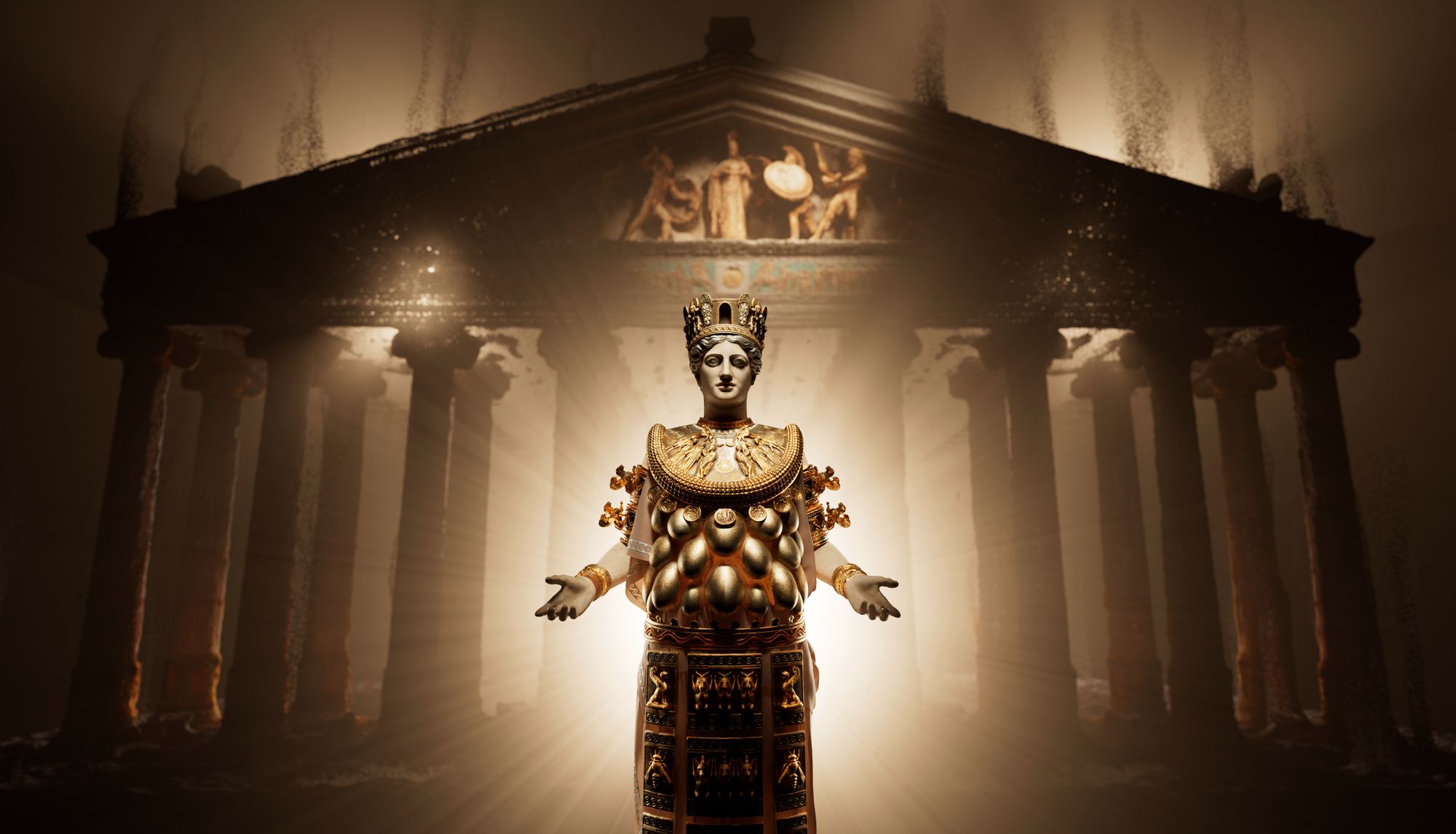
- Room three · ArtemisA one-to-one replica of the Artemis of Ephesus statue, surrounded by vertical LED monoliths — a one-minute finale.


The 360° hall, previsualised before production.
Accuracy
Built with historians.
We worked alongside historians throughout. Every asset — architecture, costume, armour, the statue itself — had to be historically consistent, not just beautiful.
The Artemis of Ephesus was sculpted detail by detail, from the crown to the reliefs on her chest, before a single frame was lit.


Character assets, each checked for period accuracy.
Month one
Find the language first.
We spent the first month on design exploration only: picking key scenes and testing what we could do with them. Production started once the style was set.
Below, seven material studies for a single figure.

The hard part
A world that comes apart.
The biggest challenge was moving a camera through the 360° hall. The look we wanted had a solid centre and edges — and a floor — that dissolve into drifting points.
So we had to model our own 3D world, render it, and then effectively 3D-scan it back. We rendered each shot in 360°, used the normal and position passes to turn the entire world into a point cloud in Houdini, and simulated those points. Every shot was rendered twice: once as mesh, once as particles. Getting that system to work was one of the hardest parts of the project.
Drag across the image to compare.

 MeshPoint cloud


The story
The night the temple burned.
The 360° film builds to the burning of the Temple of Artemis. Legend says the goddess couldn't protect her temple that night — she was away, attending the birth of Alexander the Great.


Rendering
When render farms said no, we built one.
Commercial render farms either quoted prices that made the project impossible, or rendered a few frames and refunded us — they couldn't handle the scenes.
So we built our own: 20 machines, each with two RTX 4090s and 128 GB of RAM, linked together with Deadline. We rendered throughout the six months of production, and then spent the final month doing nothing but rendering.
In the museum
At Ephesus.
The Ephesus Experience Museum sits beside the ancient city at Selçuk.

The film
Watch it.
Credits
Who did what.
- Venue
- Ephesus Experience Museum, Selçuk
- Design, 3D content & rendering
- Nongravital
- Historical consultancy
- Historians working with the project
- Tools
- Cinema 4D, Houdini, ZBrush, Octane, Redshift, Deadline
- Photography
- S. Ciampone
Museum or immersive space in the works?